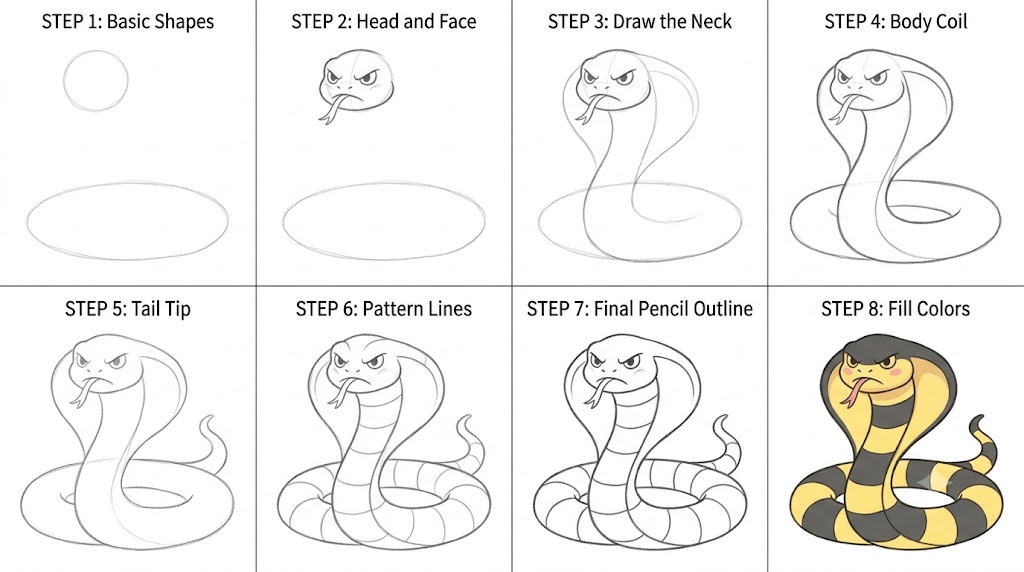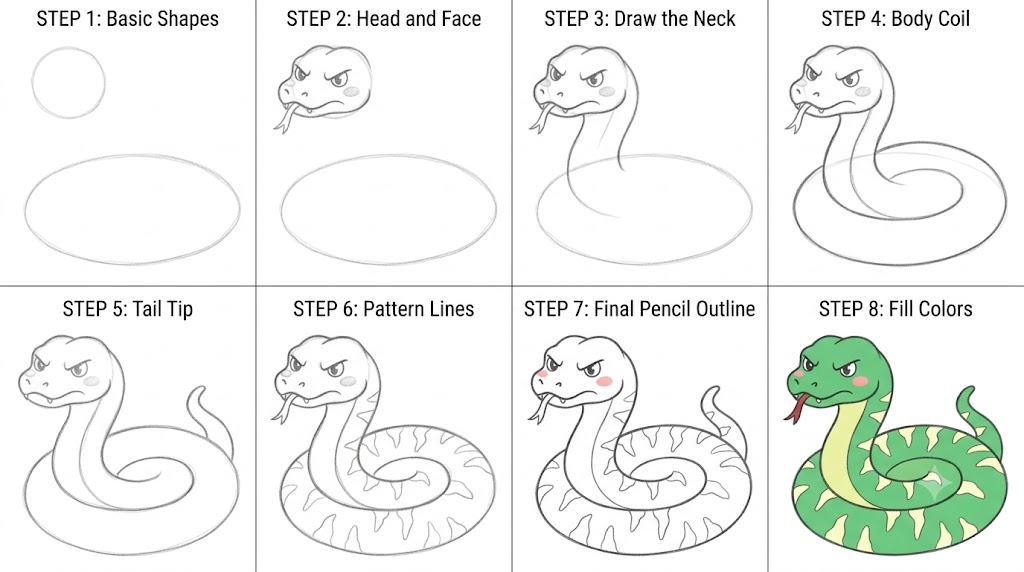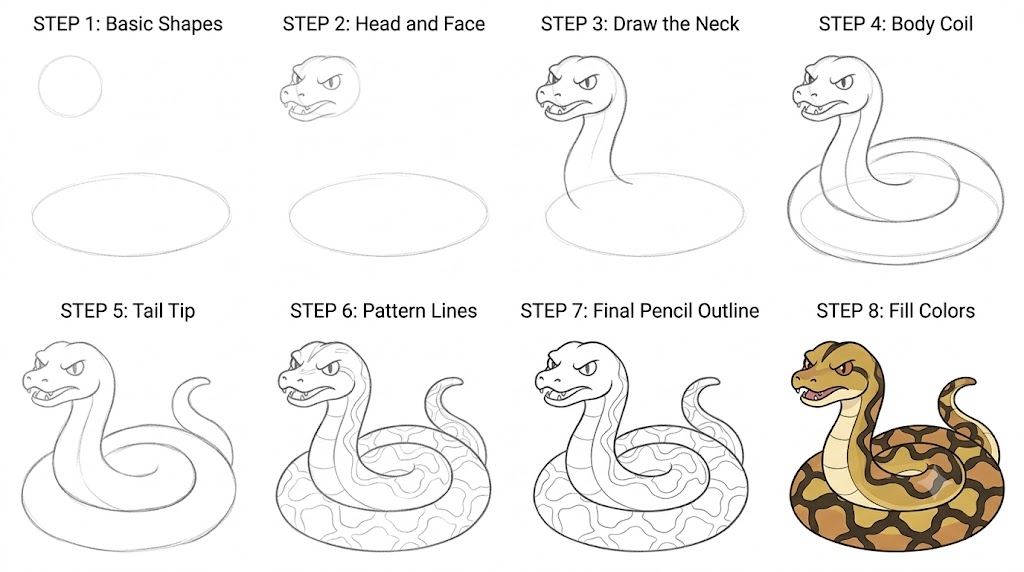
Easy Snake Drawing: How to Draw a Cute Snake Step by Step
Easy snake drawing in 8 simple steps. Draw a cute, simple snake with curves and patterns. A snake drawing easy enough for kids and beginners.
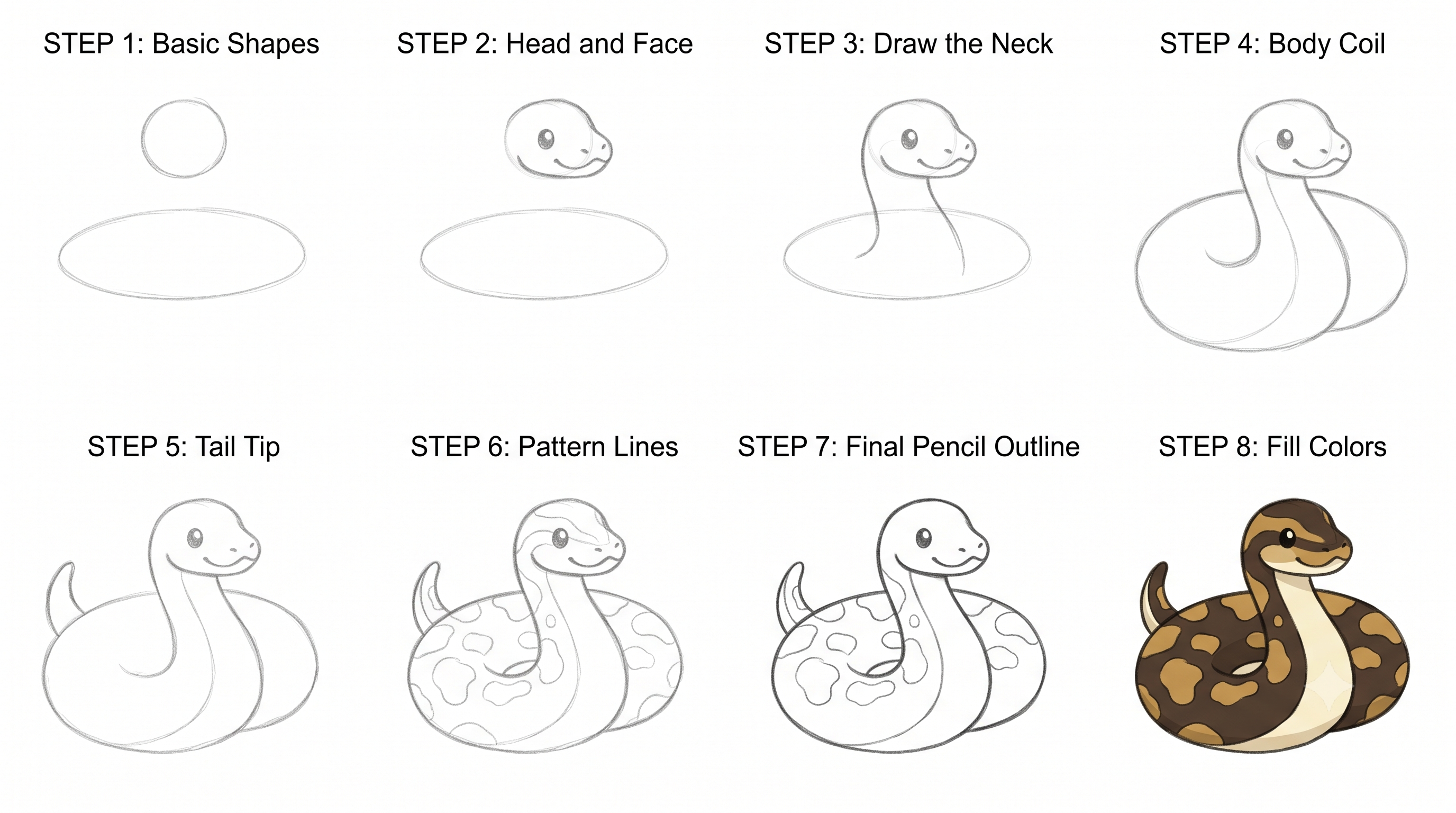
Tip: Click open high-res plate to view close-up strokes, line variations, and pencil guide erasures.
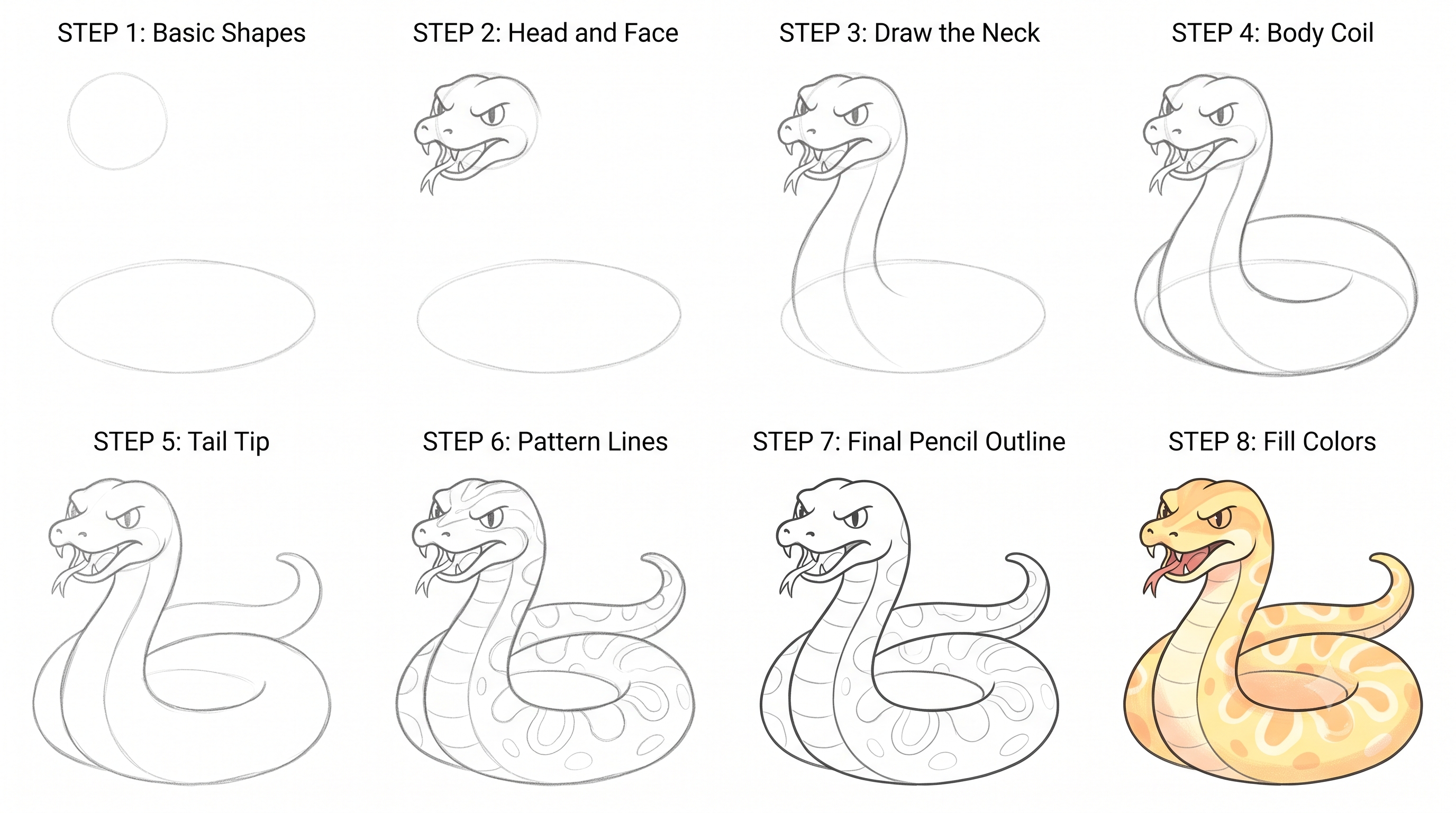
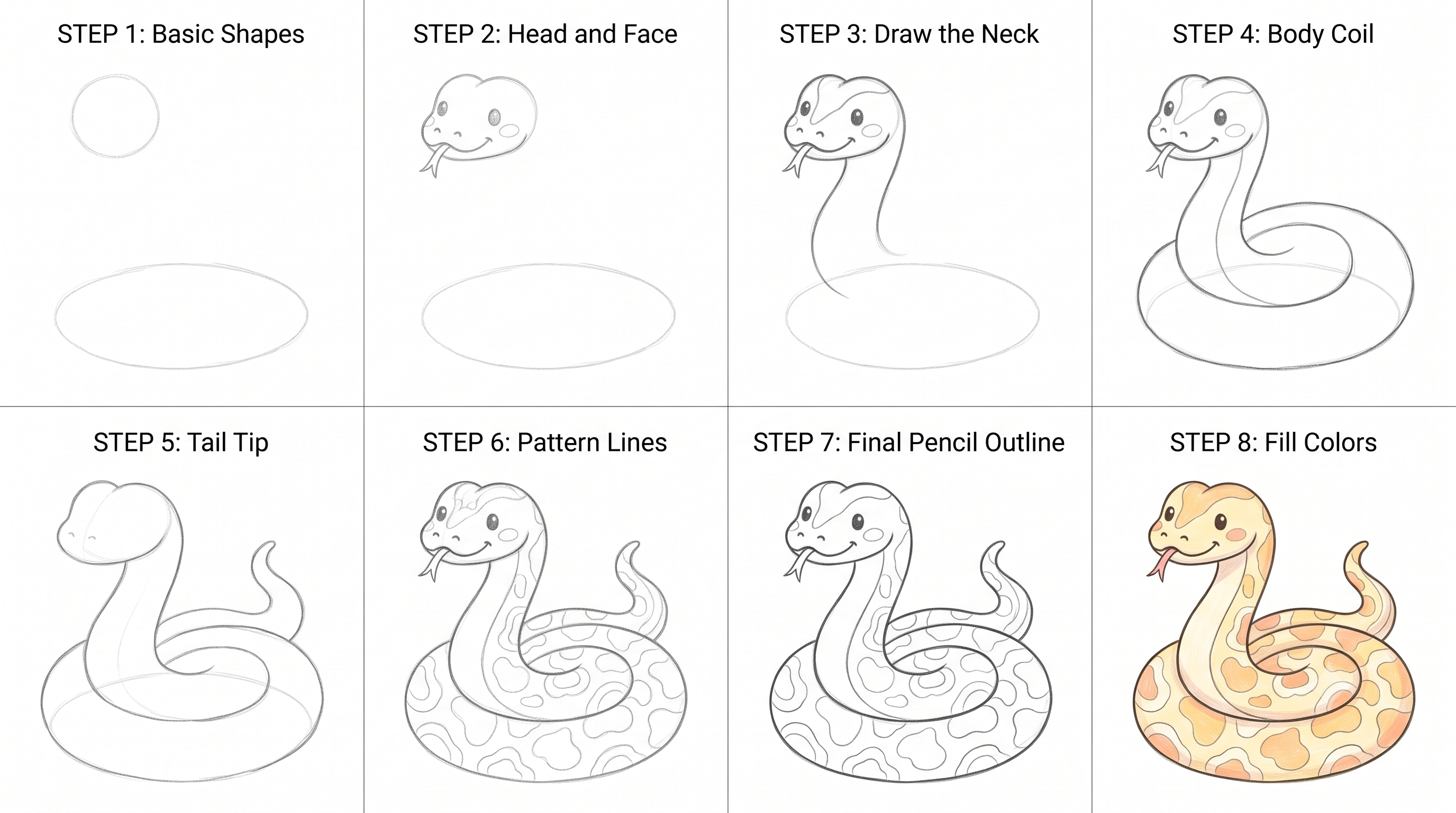
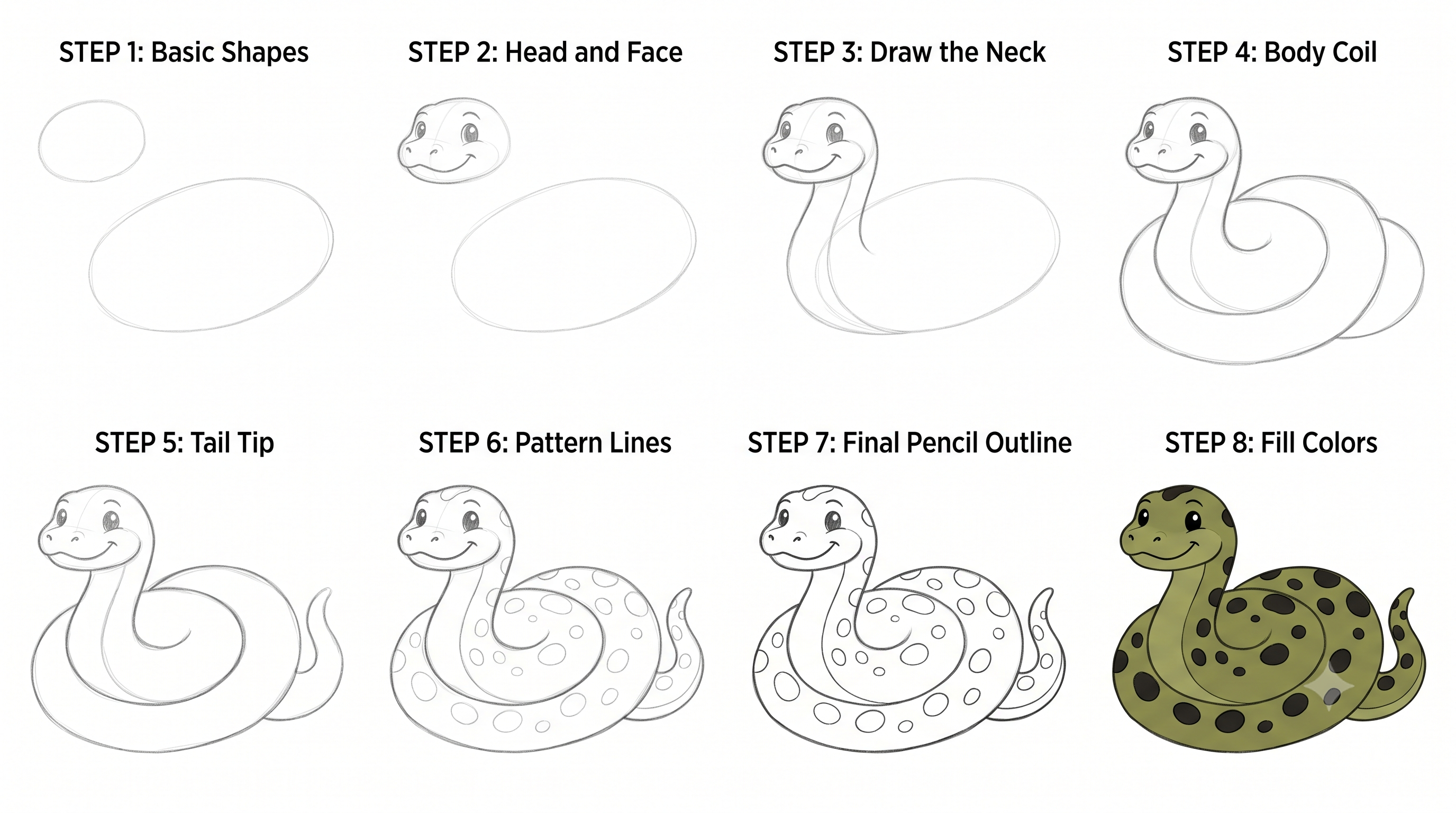
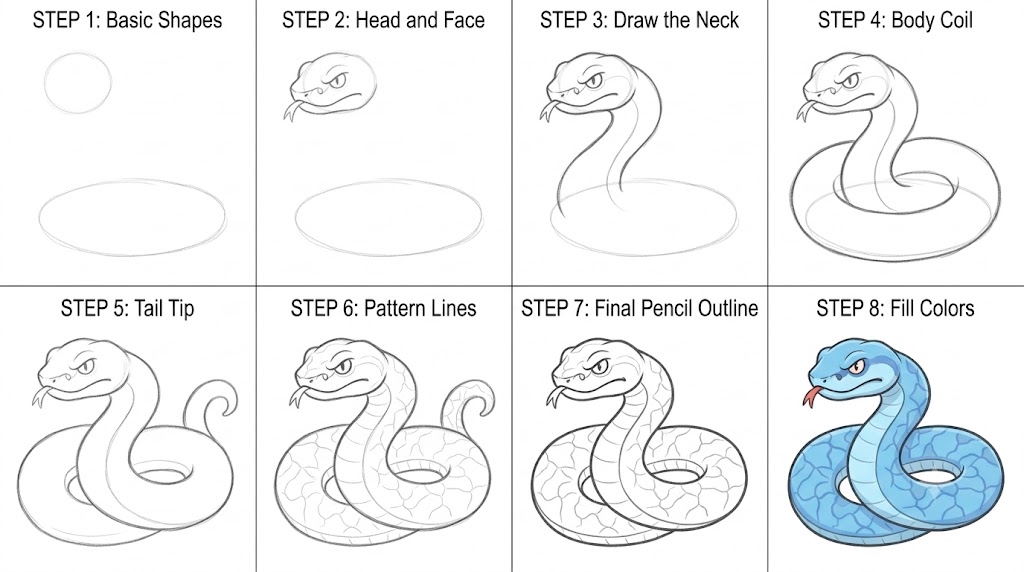
This is a snake drawing easy enough for anyone, because a snake is just one long curvy line with a head. In 8 steps you can draw a cute snake with a friendly face and a colorful pattern. It is a simple snake drawing that kids love.
What You Need
A pencil, an eraser, paper and colors. Estimated Time: 5 minutes.
How to Draw a Snake Step by Step
- Draw a long wavy “S” shape for the body.
- Draw a second line beside it to give the body thickness.
- Round off the head at one end and taper the tail at the other.
- Add two big eyes and a small smile.
- Draw a thin forked tongue.
- Add patterns on the body, like stripes, dots or diamonds.
- Trace the final lines and erase the guide lines.
- Color your snake in green, yellow or any bright colors.
Cute Snake Drawing Tips
- Big eyes and a small smile make a snake look cute instead of scary.
- Keep the curves smooth and round.
- Use repeating patterns so the body looks neat.
FAQ
How do I draw a snake easy? Start with a wavy line, then give it thickness and add a head.
How do I make a cute snake drawing? Use large eyes, a smile and soft colors.
What is the simplest snake pattern? Stripes or dots repeated along the body.
Step-by-Step Instructions
Follow each panel in sequence. Start with faint guideline circles and finish with saturated color.
Foundational Guide Shapes & Proportions
Begin by lightly sketching the primary construction lines and geometry (circles, ovals, or center axes). Keep your pencil strokes faint with an HB or 2H pencil as these scaffold marks will be erased later.
Core Form & Center Anatomy
Build upon your initial scaffold by establishing the central anchor point of the subject—such as the head/body segment, floral core, central trunk, or cranial curve.
Inner Contours & Secondary Shapes
Extend outward from the core to map secondary landmarks, such as antennae, inner petal layers, branch splits, or serpentine coils.
Upper Contours & Main Silhouette
Sketch the sweeping upper boundaries (forewings, crowning petals, high canopy foliage, or primary body arc). Establish clear flowing outer edges.
Lower Contours & Base Features
Balance the composition by adding lower elements (hindwings, descending foliage, root systems, or ground-level coiling curves). Check overall proportions.
Surface Textures & Anatomical Details
Incorporate distinctive organic patterns: wing venation, petal veins, bark grain, scale textures, or fur directions. Use slightly crisper line work.
Refined Pencil Outline & Clean Up
Carefully ink or pencil in the definitive contour lines using varying stroke weights. Once the ink or main lines are dry, gently erase the initial Step 1 guide lines.
Final Coloring, Shading & Highlights
Apply flat base tones followed by deeper shadow gradients and delicate highlights. Use colored pencils, markers, watercolours, or digital brushes to bring the plate to life.
Frequently Asked Questions
How do I draw a snake easy?
Draw a long flowing "S" line, parallel it with a second line for body thickness, and round off the head.
How do I make a cute snake drawing?
Use large friendly eyes, a smiling mouth, and soft pastel shades instead of harsh sharp angles.
What is the simplest snake pattern?
Simple colored stripes, rings, or polka dots repeated down the length of the body.
Ready to Practice Offline?
Print the tutorial sheet for Albino Burmese Python angry to sketch with pencil and paper anytime at home or school.